The White-winged Dove (Zenaida asiatica) is a dove whose native range extends from the south-western USA through Mexico and the Caribbean. It has also been introduced to Florida.
Most populations of White-winged Doves are migratory, wintering in Mexico and Central America. The White-winged Dove inhabits scrub, woodlands, desert, and cultivated areas. It builds a flimsy stick nest in a tree and lays two cream-colored to white, unmarked eggs. Its flight is fast and direct, with the regular beats and occasional sharp flick of the wings that are characteristic of pigeons in general.
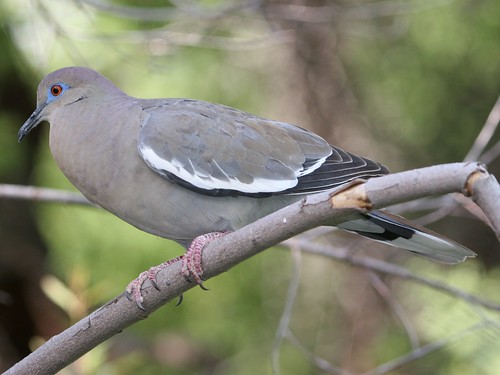
White-winged Doves are large, chunky pigeons at 29 cm. They are brownish-gray above and gray below, with a bold white wing patch that appears as a brilliant white crescent in flight and is also visible at rest. Adults have a patch of blue, featherless skin around each eye and a long, dark mark on the lower face. Their eyes, legs, and feet are red.
Both sexes are similar, but juveniles are grayer than adults. They have no blue eye ring and their legs and feet are brownish pink.
White-winged Doves feed on a variety of seeds, grains, and fruits. Western White-winged Doves (Zenaida asiatica mearnsii) migrate into the Sonoran Desert to breed during the hottest time of the year because they feed on pollen and nectar, and later on the fruits and seeds of the Saguaro cactus. This gregarious species can be an agricultural pest, descending on grain crops in large flocks. It is also a popular gamebird in areas of high population.
The cooing calls are who-cooks-for-you and hoo hoo hoo.
Most populations of White-winged Doves are migratory, wintering in Mexico and Central America. The White-winged Dove inhabits scrub, woodlands, desert, and cultivated areas. It builds a flimsy stick nest in a tree and lays two cream-colored to white, unmarked eggs. Its flight is fast and direct, with the regular beats and occasional sharp flick of the wings that are characteristic of pigeons in general.
White-winged Doves are large, chunky pigeons at 29 cm. They are brownish-gray above and gray below, with a bold white wing patch that appears as a brilliant white crescent in flight and is also visible at rest. Adults have a patch of blue, featherless skin around each eye and a long, dark mark on the lower face. Their eyes, legs, and feet are red.
Both sexes are similar, but juveniles are grayer than adults. They have no blue eye ring and their legs and feet are brownish pink.
White-winged Doves feed on a variety of seeds, grains, and fruits. Western White-winged Doves (Zenaida asiatica mearnsii) migrate into the Sonoran Desert to breed during the hottest time of the year because they feed on pollen and nectar, and later on the fruits and seeds of the Saguaro cactus. This gregarious species can be an agricultural pest, descending on grain crops in large flocks. It is also a popular gamebird in areas of high population.
The cooing calls are who-cooks-for-you and hoo hoo hoo.